: A specialized e-commerce store for motorsport and automotive
Documentation / WooCommerce / Products / Managing Product Categories, Tags and Attributes
Managing Product Categories, Tags and Attributes
Product categories, tags, and attributes are different ways you can use to organize, display, and filter products in your WooCommerce store. Being technical, you would call these product taxonomies. Though their uses overlap a bit, each one serves a slightly different purpose. In this document we’ll explore these three fundamental taxonomies for organizing and managing your product catalog effectively.
Categories: Functioning with a hierarchical structure, Categories enable merchants to group their products into broad, navigable sections, simplifying the browsing process for customers. This hierarchical nature allows for the creation of parent and child categories, offering a structured and intuitive way to navigate through products.
We’ll cover how to add categories, organize them, and add them to your site’s menu
Tags: In contrast, Tags lack a hierarchical structure and provide a more flexible way of associating products. Tags are useful for applying specific descriptors to products, facilitating the discovery of related items based on shared characteristics, without the need for a rigid organizational framework.
We’ll cover what tags are, when you might want to use them, and how to add them.
Attributes: Attributes are crucial for creating variable products. Attributes can also be used to enhance the product filtering and selection process, allowing customers to find and select products that meet their specific preferences or needs.
We’ll cover the uses of product Attributes, tools for displaying and filtering products by attribute, how to add global attributes that you can use across many products, and how to add custom attributes on a per-product basis.
Product categories
Product categories are the primary way to group products with similar features. Categories are hierarchical, meaning they have parent > children relationships. This means you can add subcategories if desired.
For example, if you sell clothing, you might have “shirts”, “hoodies” and “pants” as top-level categories. You could add “short-sleeve” and “long-sleeve” as subcategories of the “shirts” parent category.
Each subcategory can only have one parent, but parents can have multiple subcategories. Subcategories can be nested several layers deep. Generally we recommend to keep things as simple as possible.
How to add/edit product categories
Categories are managed from the Products > Categories screen.
Similar to categories on your posts in WordPress, you can add, delete, and edit product categories.
To create a new product category:
Navigate to the the Products > Categories screen.
In the “Add new category” form, Enter a Name.
Add a Slug (optional); this is the URL-friendly version of the name. If you don’t enter one, the system will auto-generate one for you based on the category name.
Choose a Parent category if this will be a subcategory.
Enter a Description (optional); some themes display this. Most often beneath the category name on the category’s landing page
Choose the Display type. Decide what is shown on the category’s landing page. Choosing “default” uses your theme’s default. “Subcategories” will display only the subcategories. “Products” only displays products. “Both” will display subcategories then products below that.
Upload/Add Image (optional); Some themes have pages where product category images are displayed, so this is a good idea.
The Storefront theme by default displays product category images on the homepage template as shown in the screenshot below.mmerce system where you can organize multiple shops and stores such as digital stores, fashion stores, sports stores, home & living stores, health & beauty stores, and many others in one platform. In simple words, you’ll get All Things Under One Roof!
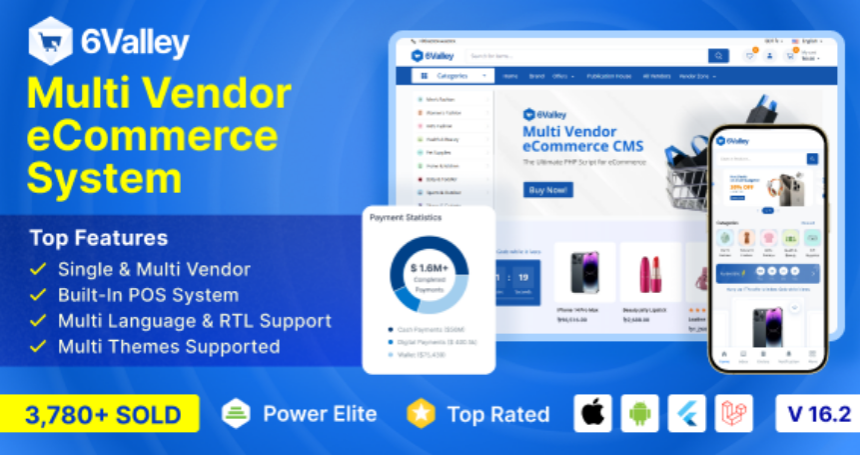
Business owners dealing with eCommerce, electronics shops, online shops, online delivery, order, and Multi-vendor/Single-vendor online business will find this package to be extremely useful. You can offer your customers the best shopping experience with its mobile-optimized design.
This script is a clean and modern solution for online marketplaces. With a clean, trendy design, 6valley will make your online store more impressive and appealing. Enhance your customers’ ability to buy your products quickly by increasing your conversion rate.
PHP Laravel is used to develop both the Web frontend and Admin panel for 6valley. It will also be available on iOS and Android thanks to Flutter’s cross-platform development!
15+ Reasons to Buy 6valley:
A complete multi-vendor eCommerce system.
Easy to organize shops and stores under one e-Commerce system.
2 SUPERB Web panels: Admin Panel & Seller panel. (Developed Using Laravel)
3 mobile applications: User app, S